
Have you ever written a message or social media comment using no difference or no different and wondered which phrase is correct? You are not alone!
These expressions look almost identical, but they work differently in English. One is grammatically correct when talking about things being the same, while the other usually sounds incomplete or unnatural without additional words.
Whether you are chatting with friends, writing an Instagram caption, or improving your English for everyday conversations, understanding the difference can help you sound more natural and confident.
Let’s explore the meanings, grammar rules, real-life examples, and common mistakes so you can choose the right phrase every time.
Quick Answer:
No difference is the correct phrase when you mean that two or more things are the same. No different is usually incorrect on its own, but different can be used naturally in sentences such as They are not different.
What Does No Difference vs No Different Mean?
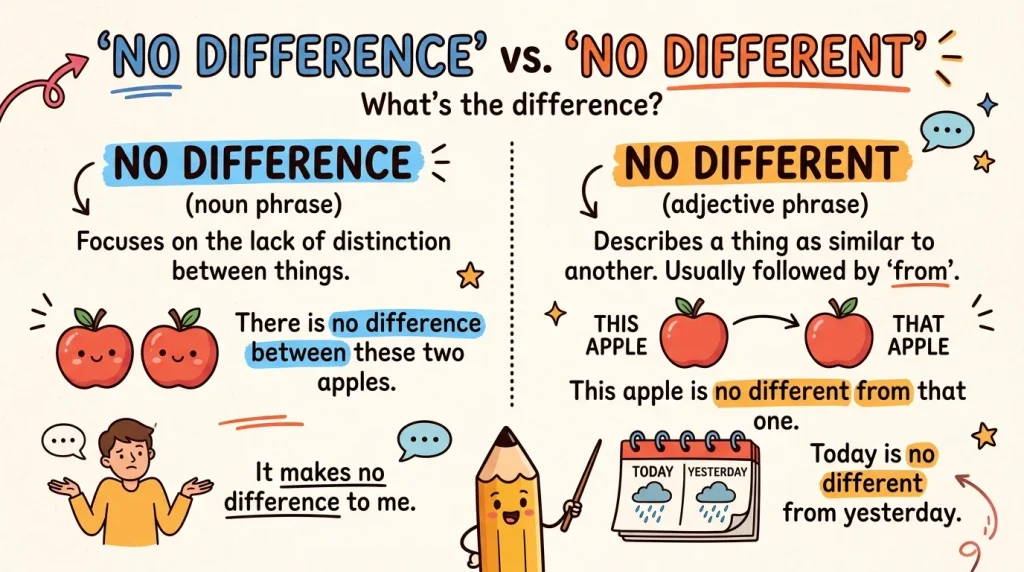
The main difference between no difference and no different comes down to grammar.
What Does No Difference Mean?
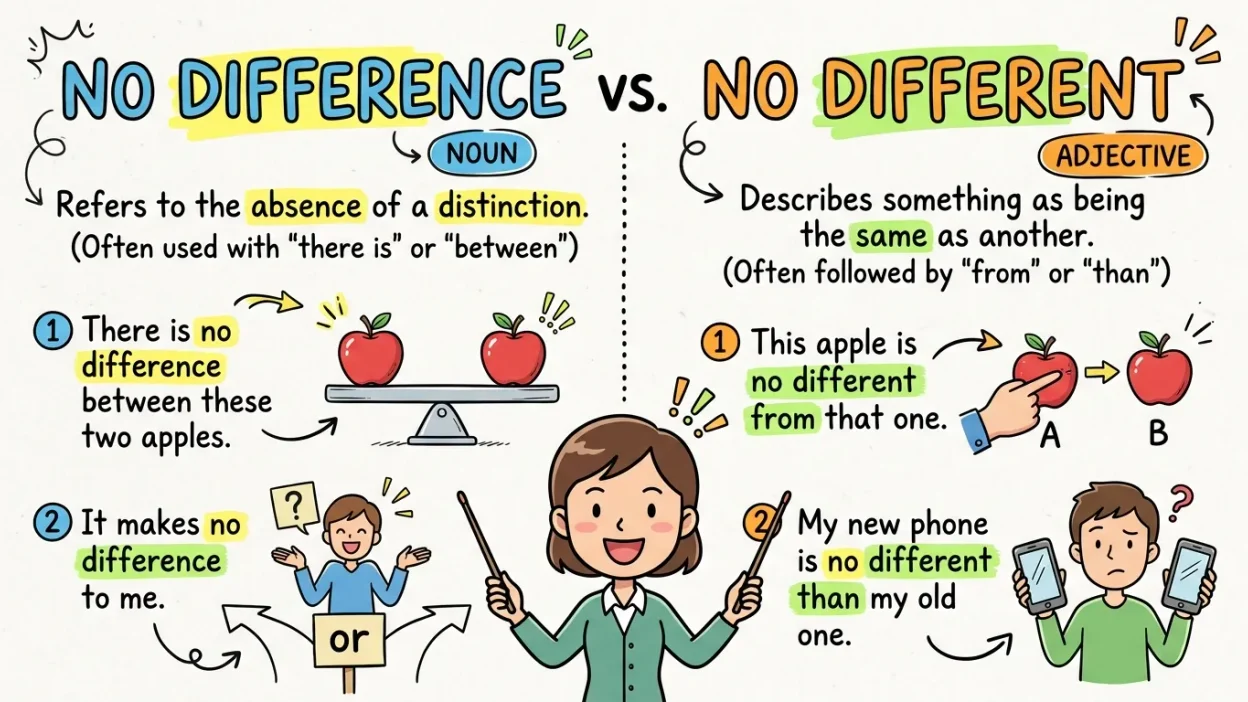
No difference means that there is no change, distinction, or noticeable variation between two or more things. The word difference is a noun, so it can follow the word no.
Examples:
- There is no difference between these two pictures.
- I see no difference in your new haircut.
- It makes no difference to me where we eat.
- There is no difference between the two options.
In everyday texting, people might use no difference to explain that two choices are equally acceptable or that something does not matter to them.
Example conversation:
A: do you want pizza or burgers tonight? 🍕🍔
B: no difference to me, you choose 😄
Here, the speaker means that either option is fine.
What Does No Different Mean?
No different is generally not grammatically natural when used alone to mean that two things are the same. The word different is an adjective, and English normally uses it with a verb or another grammatical structure.
For example:
- Incorrect or unnatural: These two phones are no different.
- More natural: These two phones are not different.
- Also correct: These two phones are no different from each other.
The last sentence is acceptable because no different is part of the expression no different from, which means that two things are alike in the relevant way.
Here are some more examples:
- Your opinion is no different from mine.
- This version is no different from the original.
- His approach is not different from hers.
In short: No difference = no distinction or variation. No different = usually incomplete alone, but correct in expressions such as no different from.
Where Is No Difference vs No Different Commonly Used?
These phrases are not slang abbreviations like LOL or IDK. They are ordinary English expressions that people use in conversation, writing, and online communication.
Here are some common situations where you may encounter them:
- 📱 Text messages: Use no difference to say that either choice is fine.
- 👻 Snapchat: People might use no difference when choosing between filters, photos, or plans.
- 📸 Instagram: The phrase can appear in comments comparing two outfits, pictures, or products.
- 🎵 TikTok: Users may discuss whether two videos, trends, or versions are different.
- 💬 WhatsApp: Friends and family can use no difference when discussing everyday decisions.
- 🎮 Gaming chats: Players may compare two game settings or strategies and explain that there is no difference.
- 📚 English learning: Students often compare these phrases while studying nouns, adjectives, and sentence structure.
- 💼 Work communication: Both expressions can appear in professional discussions, but complete and precise sentences are preferable.
The tone depends on the sentence. No difference is neutral and suitable for casual or formal contexts when used correctly. No different from is also appropriate in both casual and professional English.
However, a short reply such as no difference to me may sound relaxed, while a sentence such as There is no significant difference between the two results sounds more formal.
Examples of No Difference vs No Different in Conversation
These seven examples show how to use both expressions naturally.
1. Choosing Food
A: should we order noodles or rice? 🍜
B: no difference to me, i’m good with either 😂
Meaning: The speaker does not have a preference.
2. Comparing Pictures
A: do these pictures look different?
B: honestly, there’s no difference 😅
Meaning: The pictures appear the same.
3. Talking About Clothes
A: is this jacket different from the old one?
B: it’s no different from your old jacket tbh
Meaning: The two jackets are essentially alike.
4. Discussing Plans
A: should we meet at 5 or 6?
B: no difference for me, whatever works for you 😊
Meaning: Both times are acceptable to the speaker.
5. Comparing Phones
A: is the new phone much better?
B: there’s no difference in performance from what i can tell 📱
Meaning: The speaker has not noticed a change in performance.
6. Comparing Opinions
A: do you think our opinions are different?
B: we’re no different from each other on this 😂
Meaning: The speakers share the same opinion on that topic.
7. Talking About a New Version
A: did they improve the new update?
B: it seems no different from the previous version 🤔
Meaning: The new update appears very similar to the old one.
Notice that the correct phrase depends on how the sentence is constructed. No difference works naturally as a noun phrase, while no different generally needs a structure such as no different from.
When to Use and When Not to Use No Difference vs No Different
Understanding a phrase is only part of learning English. You also need to know when it sounds natural.
✅ When to Use No Difference
- When comparing two things: There is no difference between these products.
- When expressing no preference: It makes no difference to me.
- When discussing results: There was no difference in the final scores.
- When chatting casually: No difference to me, you decide.
- When writing formally: The study found no significant difference between the groups.
❌ When Not to Use No Difference or No Different
- Avoid using no different alone: Write They are not different or They are no different from each other.
- Avoid incomplete sentences in formal writing: Use a complete sentence such as There is no difference between the two methods.
- Avoid confusing nouns and adjectives: Difference is a noun; different is an adjective.
- Avoid assuming the phrases are interchangeable: They follow different grammatical patterns.
- Avoid vague comparisons: Specify what is being compared when readers might not understand your meaning.
Correct vs Incorrect Usage
| Context | Example Phrase | Why It Works |
|---|---|---|
| Friend chat | No difference to me 😄 | Casual way to express no preference |
| Product comparison | There is no difference between them. | Correct noun construction |
| Work chat | These options are no different from each other. | Correct adjective construction |
| Formal email | We found no significant difference between the results. | Clear and professional |
| Incorrect or unnatural alone | These options are no different. | Usually needs a clearer construction in standard usage |
One important clarification: These options are no different is actually acceptable English in many contexts. The issue is not that no different is always wrong; it is that it often needs a complete grammatical structure or a clear comparison. When in doubt, use They are not different or There is no difference.
Similar Words or Alternatives
If you want to communicate that two things are alike, several other expressions may help.
| Expression | Meaning | When to Use |
|---|---|---|
| The same | Identical or alike | Everyday conversation |
| No change | Nothing has changed | Updates or situations |
| Identical | Exactly alike | Precise comparisons |
| Alike | Similar in important ways | People, objects, or ideas |
| Not different | Not distinct from something else | Simple explanations |
| No distinction | No meaningful separation between things | Formal writing |
Examples:
- The same: These two shirts are the same.
- No change: There has been no change in the schedule.
- Identical: Both documents are identical.
- Alike: The two sisters look alike.
- Not different: The results are not different from last year’s results.
- No distinction: There is no distinction between the two categories in this context.
These alternatives can make your writing clearer, but choose one that accurately describes the relationship between the things you are comparing.
FAQs About No Difference vs No Different
1. Is no difference grammatically correct?
Yes. No difference is grammatically correct when referring to the absence of a distinction or variation between things.
2. Is no different grammatically correct?
It can be correct in a complete sentence, especially in the expression no different from. For example, This version is no different from the original.
3. Should I say no difference or no different?
Use no difference when you mean that there is no distinction. Use no different when it forms part of a grammatical construction, such as no different from.
4. What is the difference between difference and different?
Difference is a noun that identifies a distinction or variation. Different is an adjective that describes things that are not the same.
5. Can I say it makes no difference?
Yes. It makes no difference is a common expression meaning that something does not matter or does not affect the outcome.
6. Is there no difference between these two sentences?
The meaning depends on the sentences being compared. Grammatically, no difference is a noun phrase used to say that two things have no distinction.
7. Is no different from correct English?
Yes. No different from is a standard English expression meaning that something is not different from another thing.
8. What is another way to say no difference?
You can say the same, no change, identical, or not different, depending on the context.
9. Is no difference formal or informal?
It works in both settings. In formal writing, expressions such as no significant difference may be more precise when discussing research or results.
10. Why do people confuse no difference and no different?
People often confuse them because the words have related meanings. Remember that difference is a noun and different is an adjective, so they follow different grammatical patterns.
Learning the difference between these expressions will help you write clearer messages, improve your grammar, and communicate more naturally online. When you mean that two things have no distinction, no difference is usually the simplest choice.

Emily Carter is a writer at MeaningNetworks, creating clear, engaging articles about texting slang, internet abbreviations, emojis, and social media language to help readers understand digital communication.


