
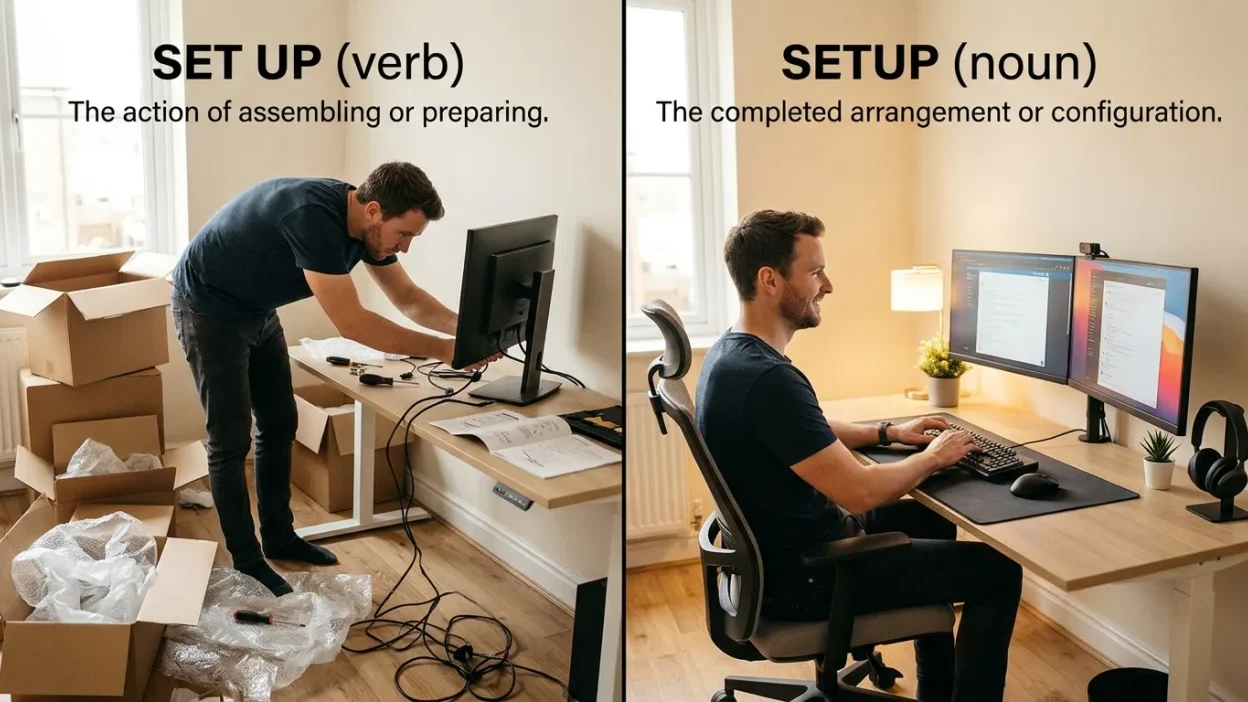
Have you ever paused while writing an email, text message, or social media post because you were unsure whether to write setup or set up? You are not alone!
These two expressions look almost identical, and many English learners and native speakers mix them up.
However, there is a simple rule that makes the difference easy to remember. One word is usually a noun or adjective, while the two-word version is a verb.
Understanding setup vs set up will help you write clearer sentences, avoid common grammar mistakes, and communicate more confidently in everyday conversations, professional emails, and online posts.
Quick Answer:
Setup is usually a noun or adjective referring to an arrangement or configuration, while set up is a verb meaning to arrange, prepare, or establish something.
What Does Setup vs Set Up Mean?
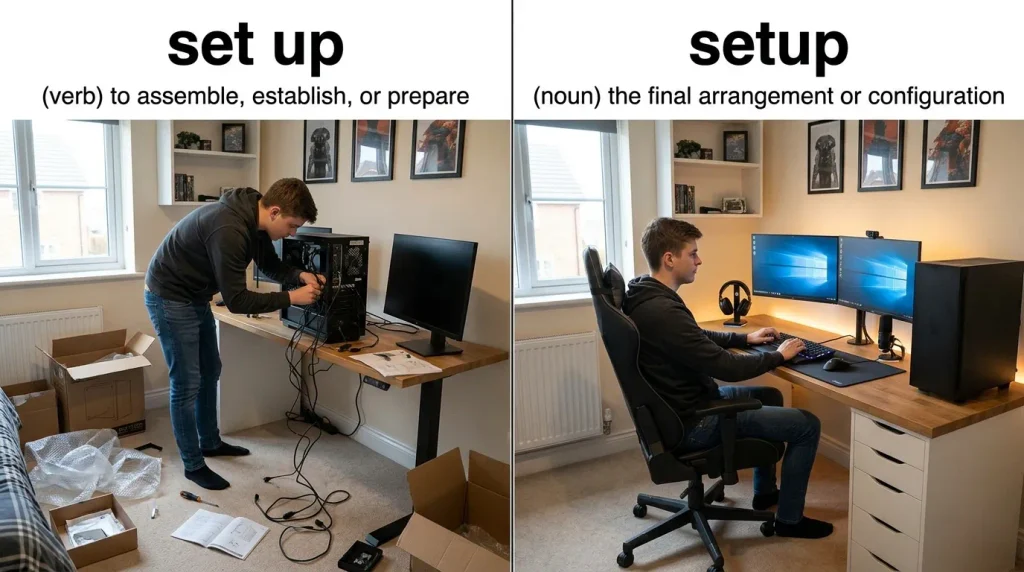
The main difference between setup and set up is how each expression functions in a sentence. Although they are closely related, they are not always interchangeable.
What Does Setup Mean?
Setup is a noun that describes an arrangement, configuration, system, or the way something is organized. It can also function as an adjective before another noun, as in setup instructions.
Examples:
- My gaming setup looks amazing. 🎮
- The office setup is simple and comfortable.
- I need help with my computer setup.
- The camera setup is ready for filming.
- These setup instructions are easy to follow.
In these examples, setup refers to an arrangement, configuration, or instructions related to preparing something.
What Does Set Up Mean?
Set up is a phrasal verb. It means to arrange, prepare, install, organize, or establish something.
Examples:
- I need to set up my new laptop.
- Can you set up a meeting for Monday?
- We will set up the chairs before the event.
- She wants to set up a new email account.
- They plan to set up a small business.
Here, set up describes an action rather than an arrangement.
In short: Setup = an arrangement or configuration; set up = the action of arranging, preparing, or establishing something.
A helpful trick is to replace the phrase with a related word. If you mean arrangement, try setup. If you mean arrange or prepare, use set up.
Where Is Setup vs Set Up Commonly Used?
You will encounter both expressions in everyday writing, online conversations, professional communication, and technology-related discussions.
Here are some common situations where these terms appear:
- 📱 Text messages: Friends might discuss a new phone setup or ask someone to set up an account.
- 🎮 Gaming: Players talk about their gaming setup or explain how to set up a controller.
- 💻 Technology: Users discuss computer setup, software configuration, and setting up new devices.
- 📸 Social media: Content creators share their studio setup or explain how to set up a recording space.
- 💼 Workplace communication: Employees might arrange a meeting or discuss the office setup.
- 📧 Emails: People use set up when requesting an action, such as setting up an appointment.
- 🏠 Home organization: Someone might describe a home office setup or set up furniture in a new room.
Unlike internet slang, setup and set up are standard English expressions. They are appropriate for casual conversations, social media posts, academic writing, and professional communication when used correctly.
For example, you can write, My desk setup looks great, or I need to set up my desk. Both sentences are correct, but they communicate slightly different ideas.
Examples of Setup vs Set Up in Conversation
These realistic examples show how to use both forms naturally in everyday texting.
1. Talking About a Gaming Station
A: bro, your gaming setup looks awesome 🎮
B: thanks! i spent all weekend improving it
Here, setup is a noun describing the gaming equipment and arrangement.
2. Installing a New Phone
A: did you get your new phone?
B: yes! i still need to set it up 📱
Here, set up is a verb describing the action of preparing the phone for use.
3. Planning a Meeting
A: can you arrange a call with the team?
B: sure, i’ll set up a meeting for tomorrow
Set up describes the action of arranging the meeting.
4. Discussing a Home Office
A: how’s your new workspace?
B: the setup is simple but really comfortable 😊
Setup refers to the arrangement of the workspace.
5. Starting a Social Media Account
A: how did you create your new account?
B: i followed a guide to set up everything
Set up refers to the process of preparing the account.
6. Preparing for a Party
A: who’s arranging the decorations?
B: i’ll set up the lights and balloons 🎈
Set up describes the action of arranging the decorations.
7. Asking About Equipment
A: what do you think of my desk setup?
B: looks clean! where did you get that lamp? ✨
Setup is a noun referring to the desk arrangement and equipment.
These examples show why choosing the correct form matters. If you are describing something that already exists as an arrangement, use setup. If you are talking about performing the action of arranging or preparing something, use set up.
When to Use and When Not to Use Setup vs Set Up
Knowing a few simple grammar rules will help you choose the correct expression without second-guessing yourself.
✅ When to Use Setup
- When describing an arrangement: My bedroom setup is comfortable.
- When talking about equipment: His streaming setup includes two monitors.
- When describing a configuration: The computer setup takes only a few minutes.
- When using it as an adjective: Follow the setup instructions carefully.
✅ When to Use Set Up
- When describing an action: I will set up the new computer.
- When arranging an event: We need to set up the tables.
- When creating an account: She wants to set up a profile.
- When organizing a meeting: Can you set up an appointment?
❌ Common Mistakes to Avoid
- Incorrect: I need to setup my laptop.
- Correct: I need to set up my laptop.
- Incorrect: My gaming set up is amazing.
- Correct: My gaming setup is amazing.
- Incorrect: We will setup the meeting.
- Correct: We will set up the meeting.
- Incorrect: The set up instructions are confusing.
- Correct: The setup instructions are confusing.
Setup vs Set Up Comparison Table
| Context | Example Phrase | Why It Works |
|---|---|---|
| Friend chat | My setup looks cool! 😎 | Noun describing an arrangement |
| Technology | I need to set up my phone. | Verb describing an action |
| Workplace | Let’s set up a meeting. | Means to arrange something |
| Please review the setup instructions. | Noun used before another noun | |
| Gaming | My gaming setup is ready. | Noun describing equipment |
| Event planning | We will set up the chairs. | Verb describing preparation |
Easy grammar tip: If you can replace the expression with arrange, prepare, or establish, you probably need set up. If you mean an arrangement, configuration, or system, you probably need setup.
One additional point: the past tense is set up, not setted up. For example, I set up my computer yesterday. The spelling stays the same in the past tense.
Similar Words or Alternatives
Several related expressions can help you understand or replace setup and set up, depending on the sentence.
| Word or Phrase | Meaning | When to Use |
|---|---|---|
| Arrangement | The way things are organized | Describing a layout or plan |
| Configuration | The way equipment or software is organized | Discussing technology or settings |
| Organize | To arrange things systematically | Planning events or tasks |
| Prepare | To make something ready | Getting ready for an activity |
| Install | To put software or equipment in place | Setting up devices or applications |
| Establish | To create or start something | Starting a business, system, or organization |
For example, instead of saying, I need to set up my workspace, you could say, I need to prepare my workspace. Both sentences describe an action.
Similarly, instead of saying, My office setup is comfortable, you could say, My office arrangement is comfortable. The first sounds more natural in many everyday situations, while the second emphasizes how the space is organized.
Remember that these alternatives are related in meaning, but they cannot replace setup or set up in every sentence.
FAQs About Setup vs Set Up
1. Is setup one word or two words?
Both forms are correct. Setup is usually a noun or adjective, while set up is a phrasal verb. The correct choice depends on your sentence.
2. What is the difference between setup and set up?
Setup describes an arrangement or configuration. Set up describes the action of arranging, preparing, or establishing something.
3. Is it setup a meeting or set up a meeting?
The correct phrase is set up a meeting because it describes the action of arranging a meeting.
4. Is it phone setup or phone set up?
Phone setup is correct when referring to the process or configuration as a noun. Set up your phone is correct when describing the action.
5. Is setup formal or informal?
Setup is standard English and works in both formal and informal writing. It is commonly used in technical documents, workplace communication, and everyday conversations.
6. Is set up a phrasal verb?
Yes. Set up is a phrasal verb that means to arrange, prepare, install, or establish something.
7. Is it set up or setted up?
The correct past-tense form is set up. For example, She set up her new account yesterday. Setted up is incorrect.
8. What is the plural of setup?
The plural noun is setups. For example, The studio has several different recording setups.
9. Can setup be used as an adjective?
Yes. Setup can modify another noun, as in setup guide, setup process, or setup instructions.
10. How can I remember setup vs set up?
Remember this simple rule: setup is usually a thing, while set up is an action. My setup is ready describes a thing, whereas I will set up the equipment describes an action.
Understanding setup vs set up is easier once you recognize the role each expression plays in a sentence. Use setup when describing an arrangement or configuration, and set up when describing an action. With a little practice, you can use both confidently in texts, emails, social media posts, and professional writing.

Olivia Bennett is a writer at MeaningNetworks, creating clear, engaging articles about texting slang, internet abbreviations, emojis, and social-media language to help readers understand modern digital communication.