
Have you ever written a sentence like I have flew to New York and wondered whether it sounds correct?
You are not alone! Many English learners confuse flew vs flown because both words come from the verb fly and describe movement through the air. Although they have similar meanings, they are used in different grammatical situations.
Choosing the correct word can make your writing clearer and help you speak English more naturally.
Whether you are writing a social media post, sending a text message, or preparing a school assignment, understanding this simple grammar rule will help you avoid common mistakes and use both words confidently.
Quick Answer:
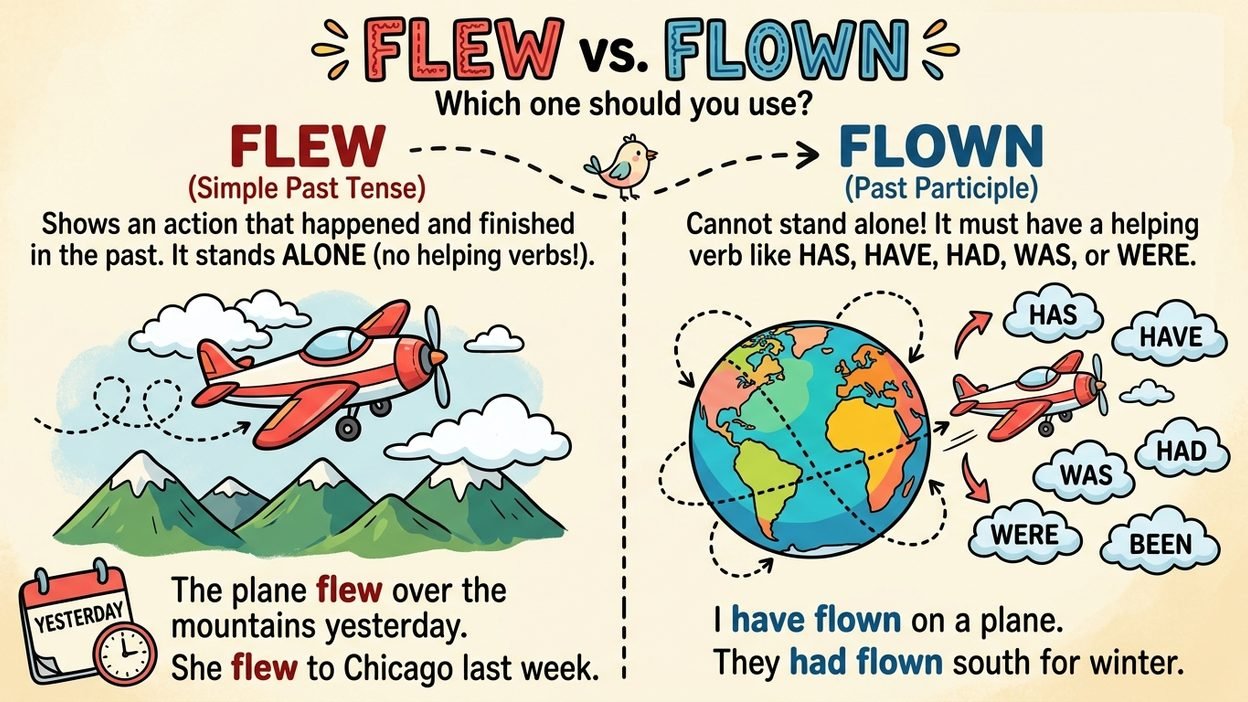
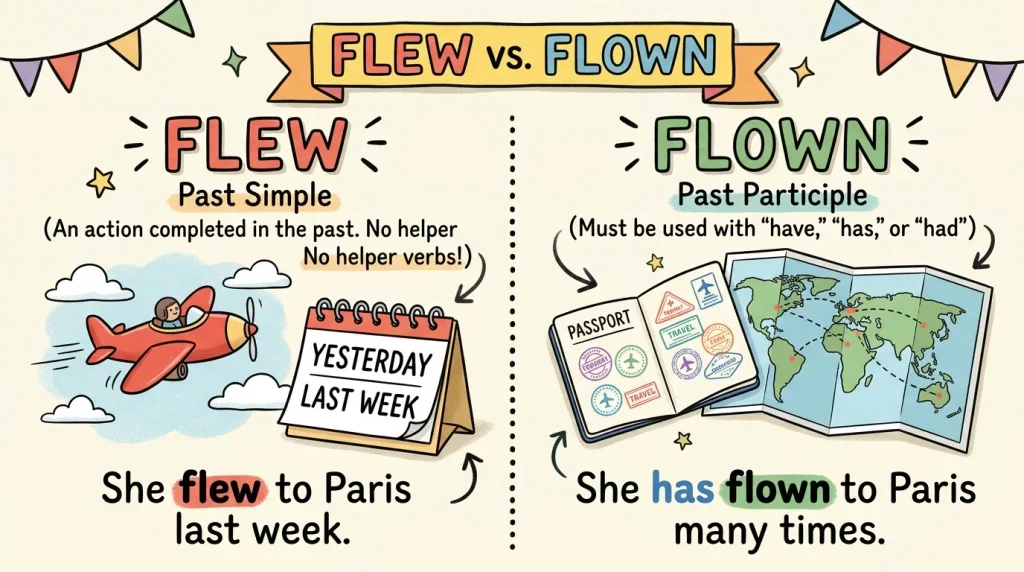
Flew is the simple past tense of fly, while flown is the past participle. Use flew for a completed past action and flown with helping verbs such as have, has, or had.
What Does Flew vs Flown Mean?
The difference between flew and flown is mainly grammatical. Both words describe the action of flying, but they are used in different sentence structures.
What Does Flew Mean?
Flew is the simple past tense of the verb fly. Use it when talking about an action that happened and finished in the past.
Examples:
- I flew to California last weekend.
- The bird flew over the garden.
- We flew to Florida for our vacation.
- She flew home after the meeting.
In these sentences, flew describes completed actions in the past. It can appear with time expressions such as yesterday, last week, or two days ago.
What Does Flown Mean?
Flown is the past participle of fly. It usually appears with helping verbs such as have, has, or had.
Examples:
- I have flown to California twice.
- She has flown across the country.
- They had flown home before the storm started.
- We have never flown internationally.
In these examples, flown works with a helping verb to form a perfect tense.
Remember that flown generally cannot replace flew on its own in a standard past-tense sentence.
Incorrect: I flown to California yesterday.
Correct: I flew to California yesterday.
Also correct: I have flown to California before.
In short: Flew = simple past tense; Flown = past participle used with helping verbs.
Where Is Flew vs Flown Commonly Used?
Flew and flown are standard English verb forms rather than slang. You will find them in everyday conversations, school assignments, travel discussions, and social media posts.
- ✈️ Text messages: I flew home last night.
- 📱 Instagram captions: Finally flew to my dream destination!
- 🎵 TikTok videos: Creators use both words when describing travel experiences.
- 💬 Everyday conversations: People talk about where they traveled or when they took a flight.
- 🎓 School and exams: English learners practise the difference between simple past and past participles.
- 📝 Emails and writing: Both forms appear in travel updates, reports, and personal messages.
- 🌎 Travel blogs: Writers use flew and flown to describe trips, journeys, and flying experiences.
These words are appropriate in both casual and formal English. The important thing is choosing the correct form for the sentence.
For example, you might text a friend, I flew to Miami yesterday, or write in a formal report, The research team has flown to several locations. Both sentences are grammatically correct.
Examples of Flew vs Flown in Conversation
Here are seven realistic conversations that show how to use flew and flown correctly.
1. Talking About Yesterday’s Trip
A: did you get to chicago yesterday? ✈️
B: yes, i flew there in the afternoon!
Why it works: Flew describes a completed action at a specific time in the past.
2. Sharing Travel Experience
A: have you ever visited japan? 🇯🇵
B: yes, i’ve flown there twice!
Why it works: Flown follows have in the present perfect tense.
3. Discussing a Family Vacation
A: how did your parents get home?
B: they flew back on sunday 😊
Why it works: Flew describes a completed trip.
4. Talking About an Earlier Event
A: was your sister home before the weather got bad?
B: yes, she had flown home before the storm started.
Why it works: Had flown describes an action completed before another past event.
5. Asking About Work Travel
A: has your manager visited the london office?
B: yes, she’s flown there several times.
Why it works: Has flown describes experience up to the present.
6. Sharing a Travel Memory
A: what was your first solo trip like?
B: i flew to new york alone, and it was amazing! 🗽
Why it works: Flew describes a particular completed event in the past.
7. Talking About Frequent Flying
A: you’ve travelled a lot this year!
B: true, i’ve flown to five different countries 🌍
Why it works: Have flown describes travel experience during a period connected to the present.
These examples demonstrate that the correct choice depends on the verb structure, not simply on whether the action happened in the past.
When to Use and When Not to Use Flew vs Flown
Understanding when to use each word will help you avoid common grammar mistakes.
✅ When to Use Flew
- For completed past actions: I flew to Boston yesterday.
- With a specific past time: They flew home last Friday.
- When telling a story: The bird flew out of the open window.
- When describing a past journey: We flew to Texas for our vacation.
- When writing a simple past-tense sentence: She flew across the ocean.
❌ When Not to Use Flew
- After have: Avoid I have flew to Paris. Write I have flown to Paris.
- After has: Avoid He has flew home. Write He has flown home.
- After had: Avoid They had flew away. Write They had flown away.
- When a perfect tense is required: Use flown with the appropriate helping verb.
When to Use Flown
Use flown after have, has, or had when forming perfect tenses.
Examples:
- I have flown before.
- She has flown to Canada.
- We had flown home before sunset.
Flew vs Flown Comparison Table
| Context | Example Phrase | Why It Works |
|---|---|---|
| Everyday conversation | I flew yesterday. | Simple past action |
| Travel story | She flew to Paris last week. | Completed past event |
| Work email | I have flown to three offices this month. | Present perfect tense |
| Past narrative | They had flown away before we arrived. | Past perfect tense |
| School assignment | The bird has flown away. | Correct use of the past participle |
One helpful rule is to look for the helping verb. If you see have, has, or had before the main verb, flown is generally the correct form.
Similar Words or Alternatives
Flew and flown belong to a group of English verbs that change form depending on tense. Learning a few similar examples can help you recognize the pattern.
| Verb | Simple Past | Past Participle | Example |
|---|---|---|---|
| Fly | Flew | Flown | She has flown abroad. |
| Go | Went | Gone | He has gone home. |
| See | Saw | Seen | I have seen that movie. |
| Eat | Ate | Eaten | We have eaten lunch. |
| Write | Wrote | Written | She has written a letter. |
| Take | Took | Taken | They have taken a taxi. |
These verbs follow a similar pattern: the simple past and past participle are often different. For example, you say I went yesterday but I have gone already, just as you say I flew yesterday but I have flown before.
Learning these forms together can make English grammar easier to remember.
FAQs About Flew vs Flown
1. Is it flew or flown?
Both are correct, but they serve different grammatical purposes. Flew is the simple past tense, while flown is the past participle.
2. Is it I flew or I have flown?
Both are correct in different contexts. Say I flew yesterday, but say I have flown before.
3. Can I say I have flew?
No. In standard English, the correct sentence is I have flown because have requires the past participle.
4. What is the past tense of fly?
The simple past tense of fly is flew.
5. What is the past participle of fly?
The past participle of fly is flown.
6. Is flown a real word?
Yes. Flown is the standard past participle of fly and is used in perfect tenses.
7. Is it she flew or she has flown?
Use she flew for a completed past action, such as She flew yesterday. Use she has flown when talking about experience or an action connected to the present.
8. Is it had flew or had flown?
The correct form is had flown. Had must be followed by the past participle in the past perfect tense.
9. What is the difference between flew and flown in American English?
The grammatical difference is the same in American English and British English. Flew is the simple past, and flown is the past participle.
10. How can I remember the difference between flew and flown?
Remember this simple pattern: I flew yesterday, but I have flown before. Use flew for simple past actions and flown with have, has, or had.
Understanding flew vs flown does not have to be difficult. Once you recognize the difference between the simple past tense and the past participle, choosing the correct word becomes much easier. Practise with your own sentences, and you will soon use both forms naturally in speaking and writing.

James Anderson is a writer at MeaningNetworks, creating clear, engaging articles about texting slang, internet abbreviations, emojis, and social-media language to help readers understand modern digital communication.


