
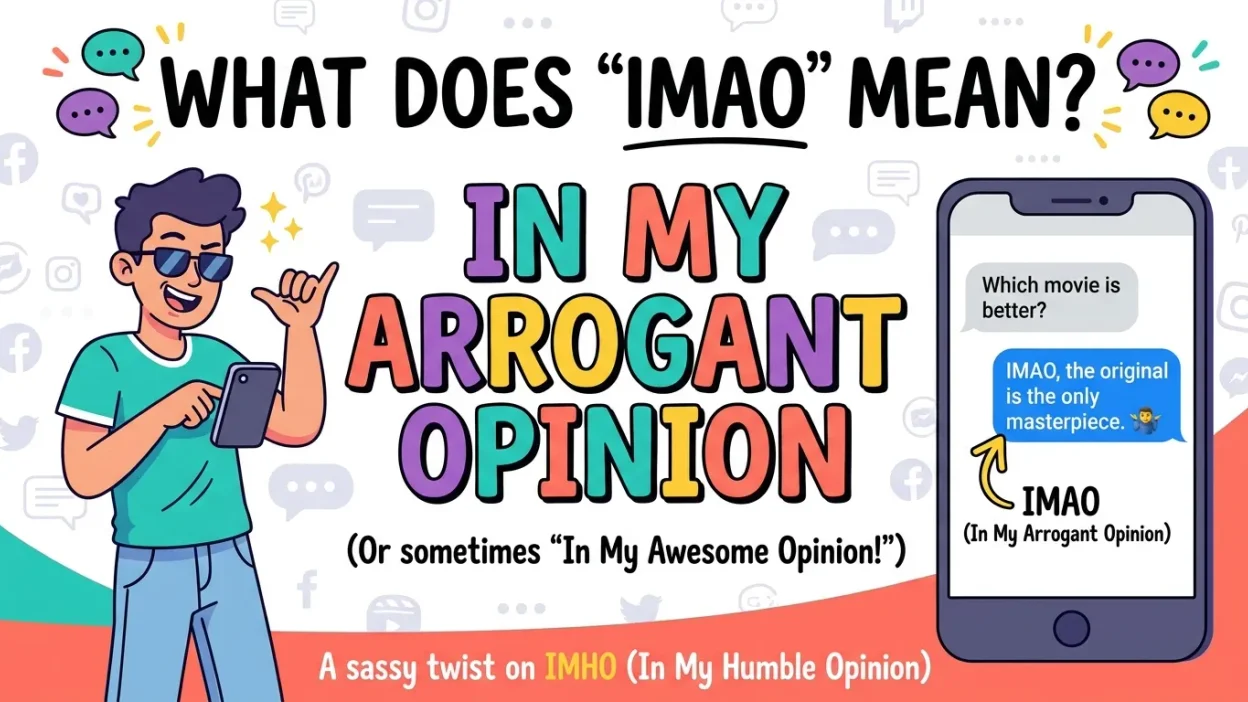
Have you ever been chatting with a friend, laughing about something funny, and suddenly noticed the abbreviation IMAO in their reply?
If you are unsure what it means, you are not alone! Internet slang can be confusing, especially when two abbreviations look almost identical but have different meanings.
IMAO is commonly used in casual online conversations to share an opinion or react to something humorously.
However, people sometimes confuse it with LMAO and other popular texting expressions.
Understanding the IMAO meaning in text will help you follow conversations on social media, understand jokes, and reply naturally without feeling lost in the middle of a chat.
Quick Answer:
IMAO commonly means In My Arrogant Opinion. It is a casual, humorous way of sharing an opinion, often with a deliberately overconfident or sarcastic tone. Some people may use it differently or mistake it for other abbreviations, so context matters.
What Does IMAO Mean in Text?
IMAO stands for In My Arrogant Opinion. People use it in text messages, online discussions, and social media comments when they want to express their opinion in a jokingly confident, arrogant, or sarcastic way.
For example, imagine your friend thinks their favorite movie is better than every other movie ever made. They might say:
IMAO, this is the greatest movie of all time 😂
In this sentence, the person is sharing a strong opinion while humorously acknowledging that they sound a little arrogant.
It is important to distinguish IMAO from IMHO, which means In My Humble Opinion. IMHO is used to express an opinion modestly, while IMAO can suggest playful arrogance. However, IMAO is less standardized, and some people may use it as a typo or mistaken version of another abbreviation.
Here are some common ways IMAO can be understood:
- 😂 Humorous confidence: Sharing an opinion in a deliberately overconfident way.
- 😎 Playful arrogance: Acting as though your opinion is obviously the best one.
- 💬 Personal opinion: Introducing a thought or judgment in an informal conversation.
- 🙃 Sarcasm: Making an exaggerated statement for comedic effect.
For example:
A: who makes the best pizza in town? 🍕
B: IMAO, my homemade pizza beats every restaurant 😂
The person is not necessarily being serious or genuinely arrogant. They may simply be joking with their friend.
In short: IMAO = In My Arrogant Opinion = a humorous way to express a confident or exaggerated personal opinion.
Where Is IMAO Commonly Used?
IMAO can appear in different online spaces, particularly where people share opinions, jokes, and personal preferences. Since it is less common than abbreviations such as LOL and LMAO, its meaning may depend on the community using it.
Here are some places where you might encounter it:
- 📱 Text messages: Friends may use IMAO when discussing music, movies, food, or everyday opinions.
- 👻 Snapchat: It can appear in casual conversations when someone makes a bold or funny statement.
- 🎵 TikTok: Users may use IMAO in comments or captions to introduce an exaggerated opinion.
- 📸 Instagram: It may appear in comments or direct messages during playful debates.
- 🎮 Gaming chats: Gamers might use it when joking about their skills, favorite characters, or gaming strategies.
- 💻 Online forums: People may use IMAO when expressing strong opinions in discussions or debates.
- 👥 Group chats: Friends can use it to make humorous claims and encourage playful arguments.
IMAO is generally informal, casual, and social-media-friendly. It is not a standard choice for professional emails, business reports, or formal communication.
For example, saying IMAO, my team is unbeatable 😂 in a group chat sounds playful. Using the same expression in a formal workplace report would be inappropriate.
Because the abbreviation is relatively uncommon, do not assume everyone will understand it. If clarity matters, simply write In my opinion or In my arrogant opinion instead.
Examples of IMAO in Conversation
The following examples show how IMAO can be used naturally in casual conversations.
1. Talking About Movies
A: what’s the best superhero movie ever? 🎬
B: IMAO, the first iron man is still unbeatable 😂
Meaning: The person is confidently sharing a favorite.
2. Discussing Food
A: pizza or burgers? 🍔🍕
B: IMAO, burgers win every single time 😎
Meaning: The person is expressing a strong opinion playfully.
3. Talking About Music
A: who’s your favorite singer? 🎧
B: IMAO, nobody does it better than my favorite artist 😂
Meaning: The person is jokingly presenting their preference as the best.
4. Friendly Gaming Debate
A: which character is the strongest? 🎮
B: IMAO, my main character destroys everyone 💀
Meaning: The person is showing playful confidence in their gaming choice.
5. Discussing Fashion
A: do you like these sneakers? 👟
B: IMAO, these are the coolest shoes ever 😎
Meaning: The person is expressing an exaggerated opinion about the shoes.
6. Joking About School
A: who gives the best presentations in class?
B: IMAO, obviously me 😂
Meaning: The person is teasing their friend by acting overly confident.
7. Talking About Weekend Plans
A: what should we do this weekend?
B: IMAO, my plan is always the best one 😏
Meaning: The person is jokingly suggesting that their ideas are superior.
These examples illustrate the intended humorous use of IMAO. Since it is not universally recognized, the surrounding conversation is important for understanding the writer’s exact meaning.
When to Use and When Not to Use IMAO
Knowing when to use IMAO can help you sound natural rather than confusing or unintentionally arrogant.
✅ When to Use IMAO
- When joking with friends: Use it to make a playful, confident statement.
- When sharing strong opinions: Introduce your preference about music, movies, food, or games.
- When being sarcastic: Make an exaggerated claim when the humorous tone is obvious.
- In casual online discussions: Use it with people who understand internet slang.
- When teasing yourself: Make fun of your own confidence in a lighthearted way.
❌ When Not to Use IMAO
- In formal emails: Write your opinion in complete, professional language.
- During serious disagreements: A jokingly arrogant tone might offend someone.
- In sensitive conversations: Avoid humor when someone needs empathy or support.
- With unfamiliar audiences: Readers may not know what IMAO means.
- When you want to sound genuinely humble: Consider using IMHO instead.
IMAO Compared With Other Communication Styles
| Context | Example Phrase | Why It Works |
|---|---|---|
| Friend chat | IMAO, my playlist is unbeatable 😂 | Playful and confident |
| Gaming chat | IMAO, I’m carrying this team 😎 | Humorous and competitive |
| Work chat | In my opinion, this option works best. | Clear and professional |
| Business email | I recommend choosing the second option. | Polite and direct |
| Serious discussion | I see it differently because… | Respectful and constructive |
The best approach is to match your language to the audience. IMAO works best when the people reading it understand that you are joking or expressing a playful opinion.
Similar Slang Words or Alternatives
IMAO belongs to the broader world of internet abbreviations. Some alternatives also introduce opinions, while others express laughter or confidence.
| Slang | Meaning | When to Use |
|---|---|---|
| IMHO | In My Humble Opinion | Sharing an opinion modestly |
| IMO | In My Opinion | Expressing a personal view |
| LMAO | Laughing My Ass Off | Reacting to something hilarious |
| LOL | Laughing Out Loud | Showing amusement in casual chats |
| TBH | To Be Honest | Sharing a candid opinion |
| LMFAO | Laughing My Freaking Ass Off (commonly, a stronger form of LMAO) | Expressing strong amusement |
IMAO vs. IMHO: IMAO suggests a jokingly arrogant opinion, while IMHO introduces an opinion in a more modest way.
IMAO vs. IMO: IMO simply means In My Opinion. IMAO adds a humorous or exaggerated sense of confidence when used as In My Arrogant Opinion.
IMAO vs. LMAO: IMAO introduces an opinion, whereas LMAO expresses laughter. They are not interchangeable.
IMAO vs. TBH: TBH signals that someone is being honest or candid. IMAO focuses on presenting an opinion with playful arrogance.
If you are unsure which abbreviation someone intended, look at the sentence around it. A message about a favorite movie probably introduces an opinion, while a reaction to a funny video may call for a laughter abbreviation.
FAQs About IMAO Meaning in Text
1. What does IMAO stand for in texting?
IMAO commonly stands for In My Arrogant Opinion. It is used to introduce a personal opinion with a humorous, overconfident, or sarcastic tone.
2. Is IMAO the same as LMAO?
No. IMAO commonly introduces an opinion, while LMAO means Laughing My Ass Off and expresses amusement.
3. What is the difference between IMAO and IMHO?
IMAO means In My Arrogant Opinion, while IMHO means In My Humble Opinion. One suggests playful arrogance; the other expresses an opinion modestly.
4. Is IMAO rude?
Not necessarily. It can be humorous among friends, but it may sound arrogant or dismissive if used during a serious conversation.
5. What does IMAO mean on Snapchat?
On Snapchat, IMAO can mean In My Arrogant Opinion when someone shares a confident or exaggerated opinion. However, not every user will recognize the abbreviation.
6. Can IMAO be used on TikTok?
Yes. It may appear in TikTok comments or captions when someone shares a humorous opinion about a trend, creator, song, or video.
7. Is IMAO formal or informal?
IMAO is informal internet slang. It is best suited to casual messages, social media, and conversations with people who understand the expression.
8. Is IMAO a typo for LMAO?
It can be a typo or a mistaken version of another abbreviation in some messages, but IMAO also has an established humorous interpretation: In My Arrogant Opinion. Context helps determine the intended meaning.
9. How should I reply when someone uses IMAO?
You can agree, disagree politely, or respond playfully. For example, That’s a bold opinion 😂 or fair enough, but I disagree 😄.
10. Is IMAO commonly used in texting?
It is less common than abbreviations such as LOL, LMAO, and IMO. If you use IMAO, make sure the context makes your intended meaning clear.
Understanding IMAO helps you recognize when someone is sharing an opinion with a humorous twist. Remember that online slang can vary between communities, so always consider the context before deciding what a message means.

William Brooks is a writer at MeaningNetworks, creating clear, engaging articles about texting slang, internet abbreviations, emojis, and social-media language to help readers understand modern digital communication.


