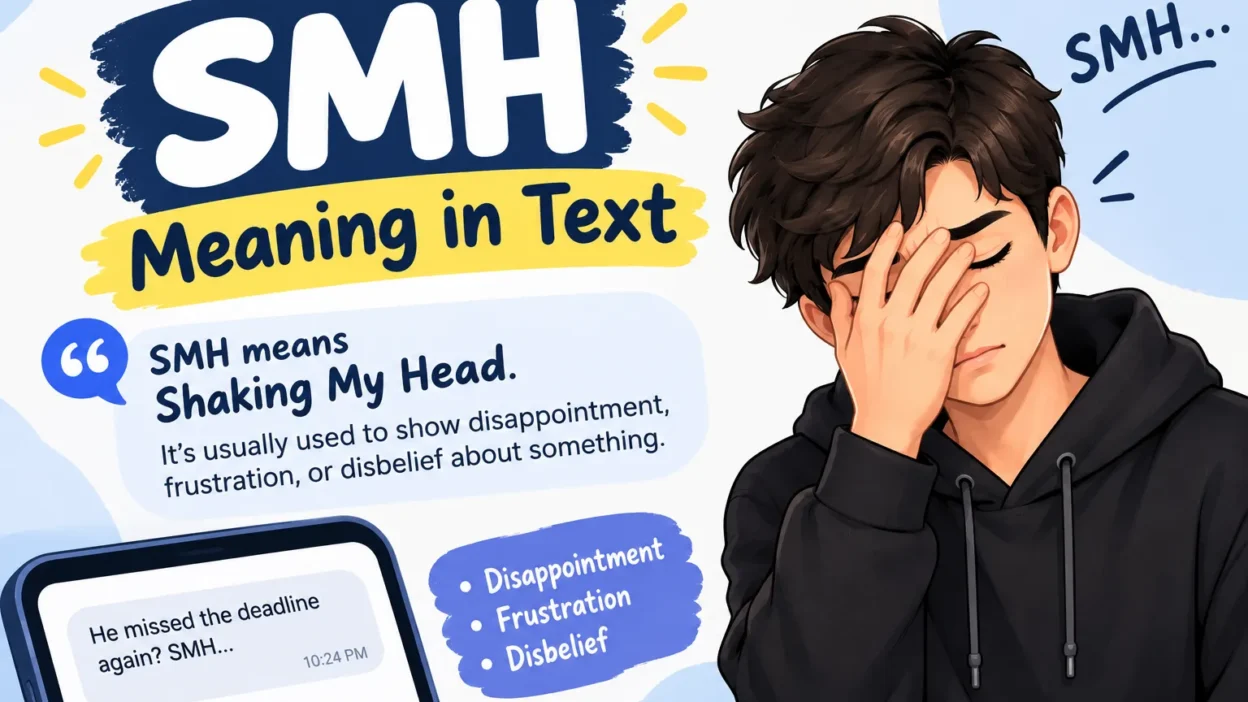
Have you ever opened a text and seen “SMH” at the end of a message and wondered what it meant? You’re definitely not alone.
I remember seeing it in a casual conversation and thinking it might be some kind of abbreviation I had missed. In texting, social media, and online chats, people often use short slang words like SMH to express feelings quickly without typing a full sentence.
Quick Answer:
SMH means “Shaking My Head.” It’s a casual way of showing disappointment, disbelief, frustration, or mild annoyance about something someone said or did.
🧠 What Does SMH Mean in Text?
SMH stands for “Shaking My Head.” It is commonly used when someone finds something disappointing, silly, frustrating, unbelievable, or difficult to understand.
The phrase comes from the physical gesture of shaking your head when you disagree with something or cannot believe what happened. In texting, SMH communicates that reaction using just three letters.
For example:
“you forgot your keys again? smh 🤦”
Here, SMH shows that the person is disappointed or amused by the other person’s mistake.
In short: SMH = Shaking My Head = showing disappointment, disbelief, or frustration.
📱 Where Is SMH Commonly Used?
SMH is especially common in informal online communication, including:
- 💬 Text messages — quick reactions to friends and family.
- 📱 Snapchat — casual responses and reactions.
- 🎵 TikTok — comments about surprising or frustrating situations.
- 📸 Instagram — comments and direct messages.
- 🐦 Social media posts — reactions to opinions, news, or funny situations.
- 🎮 Gaming chats — reacting to mistakes or unexpected gameplay.
- 💻 Online forums — expressing disbelief or frustration.
SMH is casual slang, so it works best in friendly conversations and social-media discussions. It is generally not appropriate for formal emails, professional reports, academic writing, or official communication.
💬 Examples of SMH in Conversation
Here are some realistic examples of how people use SMH in everyday texting:
1. Forgetting something
A: “i left my phone at home again 😭”
B: “smh how do you keep doing that 😂”
2. Missing the bus
A: “the bus left literally 10 seconds before i got there.”
B: “smh 😭”
3. A silly mistake
A: “i studied the wrong chapter for the test.”
B: “smh 🤦”
4. Reacting to a friend
A: “he said he can cook but burned the noodles.”
B: “smh 😂”
5. Disbelief
A: “she really posted the screenshot publicly.”
B: “smh i can’t believe it”
6. Mild frustration
A: “my internet stopped working during the meeting.”
B: “smh that’s the worst 😭”
7. Playful teasing
A: “i forgot your birthday again.”
B: “smh bro 😂”
These examples show that SMH does not always mean serious anger. Depending on the context, it can be humorous, playful, disappointed, or genuinely frustrated.
🕓 When to Use and When Not to Use SMH
✅ When To Use SMH
You can use SMH when:
- You’re chatting casually with friends.
- Something seems silly or ridiculous.
- Someone makes an obvious mistake.
- You feel mildly frustrated.
- You cannot believe something happened.
- You’re reacting to a funny situation.
- You’re commenting on social media.
- You want a short, informal reaction.
❌ When Not To Use SMH
Avoid using SMH when:
- Writing a formal business email.
- Communicating with a customer professionally.
- Writing an academic assignment.
- Discussing a serious professional issue.
- Speaking in an official or legal context.
- The other person may not understand internet slang.
For example, instead of writing “SMH” to a manager, you could say:
“I understand. I’ll make sure to correct the issue.”
SMH vs. Formal Communication
| Context | Example Phrase | Why It Works |
|---|---|---|
| Friend Chat | “you forgot again smh 😂” | Casual & friendly |
| Group Chat | “smh what just happened 😭” | Informal & expressive |
| Work Chat | “I understand. I’ll check it again.” | Polite & professional |
| “I’ll review the issue and follow up.” | Formal & clear | |
| Academic Writing | “This result is unexpected.” | Appropriate & professional |
🔄 Similar Slang Words or Alternatives
If you want to express a similar reaction, several other texting expressions can work depending on the situation.
| Slang | Meaning | When to Use |
|---|---|---|
| OMG | Oh My God | Surprise or disbelief |
| LOL | Laughing Out Loud | Something is funny |
| WTF | What the F*** | Strong surprise or frustration |
| IDK | I Don’t Know | When you are unsure |
| SMDH | Shaking My Damn Head | Stronger frustration or disbelief |
| Facepalm 🤦 | Showing embarrassment or disbelief | When someone makes an obvious mistake |
SMDH is especially similar to SMH. It means “Shaking My Damn Head” and usually adds stronger emphasis. Because it contains profanity, it is even more informal.
❓ FAQs About SMH
1. What does SMH mean in text?
SMH means “Shaking My Head.” It is used to express disappointment, disbelief, frustration, or mild annoyance.
2. Is SMH rude?
Not necessarily. SMH can be playful or humorous, but it may sound dismissive depending on the context.
3. Is SMH a bad word?
No. SMH itself is not a swear word. However, it can sometimes express criticism or frustration.
4. What does SMH mean on Snapchat?
On Snapchat, SMH usually means “Shaking My Head” and is used as a casual reaction to something surprising, silly, or frustrating.
5. What does SMH mean on TikTok?
On TikTok, SMH is commonly used in comments or captions to express disbelief, disappointment, amusement, or frustration.
6. Can I use SMH with friends?
Yes. SMH is mainly used in casual conversations with friends, family, and people who understand texting slang.
7. Is SMH formal or informal?
SMH is informal. It is better suited to texting, social media, and casual online conversations.
8. What does SMH mean from a girl?
The meaning usually depends on the context, not the person’s gender. A girl using SMH may be expressing disbelief, frustration, disappointment, or playful teasing.
9. What does SMH mean from a guy?
Similarly, a guy using SMH is usually saying “Shaking My Head” to react to something frustrating, silly, or unbelievable.
10. Does SMH mean angry?
Not always. SMH can indicate mild frustration, disappointment, disbelief, or even playful amusement.
11. What is the difference between SMH and SMDH?
SMH means “Shaking My Head,” while SMDH means “Shaking My Damn Head.” SMDH generally expresses stronger frustration.
12. Can SMH be positive?
Usually SMH is associated with a negative or disapproving reaction, but friends can use it jokingly without serious negativity.
13. Is SMH still used?
Yes. SMH remains recognizable as informal internet and texting slang.
14. What emoji goes with SMH?
The 🤦 facepalm emoji is a natural match because both can communicate disbelief, embarrassment, or frustration.
15. Can I use SMH in an email?
You generally should avoid SMH in formal emails. Use clear language such as “I’m surprised,” “I understand,” or “This is unexpected.”
16. What does SMH mean in a comment?
In a comment, SMH usually shows that the person finds a post, statement, or situation frustrating, ridiculous, or unbelievable.
17. Is SMH the same as facepalm?
They are similar but not identical. SMH describes “shaking my head,” while a facepalm usually represents embarrassment or disbelief.
18. What is the full form of SMH?
The full form of SMH is “Shaking My Head.”
19. Can SMH be used jokingly?
Yes. Friends often use SMH jokingly when teasing each other about small mistakes or funny situations.
20. What is the simplest meaning of SMH?
The simplest meaning is “I can’t believe this” or “I’m disappointed by this,” depending on the context.
🎯 Final Takeaway
SMH means “Shaking My Head.” It is a popular informal texting expression used to show disbelief, disappointment, frustration, or playful annoyance. You may see it in text messages, social media comments, Snapchat, TikTok, gaming chats, and other casual online conversations.
If a friend says “smh 🤦”, they are usually reacting to something they find silly, frustrating, or hard to believe. Just remember that SMH is casual slang, so it’s best saved for informal conversations rather than professional or formal writing.

James Anderson is a writer at MeaningNetworks, creating clear, engaging articles about texting slang, internet abbreviations, emojis, and social-media language to help readers understand modern digital communication.