Have you ever received a message like “sure.”, “fine 😂”, or “okay…” and immediately wondered, “Wait… what do they actually mean?” That little moment of confusion is exactly where decoding meaning in text comes in.
In texting, people often use short replies, emojis, slang, punctuation, and indirect language that can communicate more than the literal words.
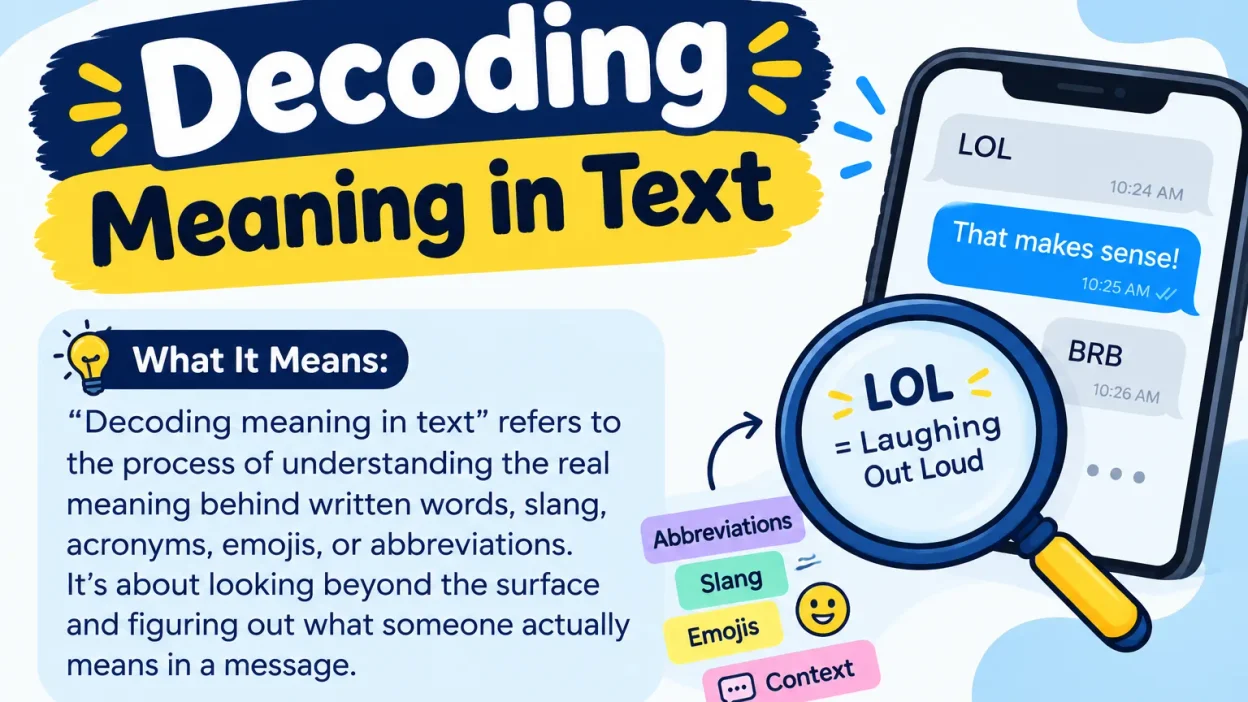
“Decoding” simply means figuring out or interpreting the intended meaning behind a message. It can involve understanding tone, context, emotion, humor, sarcasm, or implied meaning.
The phrase is not an acronym and has no special full form; it describes the process of interpreting written communication.
Quick Answer:
Decoding meaning in text means interpreting or understanding the intended meaning behind written words. It’s a neutral, casual way of saying “figuring out what someone really means.”
🧠 What Does Decoding Meaning in Text Mean?
Decoding meaning in text means looking at a written message and working out what the sender is communicating. Sometimes the meaning is direct, while other times context, emojis, punctuation, slang, or the relationship between the people helps reveal the intended message.
For example:
“I’m fine.”
Literally, the person says they are fine. But depending on the conversation, timing, punctuation, and previous messages, they could genuinely be okay—or they could be upset.
That is why decoding a text is more than simply reading the words. You consider the context, tone, word choice, emojis, and situation surrounding the message. Similar explanations of digital “decoding” emphasize interpreting intent and context rather than taking every message only at face value.
Example:
“I’m still decoding her reply 😂” means “I’m still trying to figure out what she really meant by her reply.”
In short: Decoding meaning in text = interpreting written communication = figuring out what the message really means.
Is “Decoding” an Acronym?
No. Decoding is a regular English word, not a texting acronym such as LOL, BRB, or IDK. Its dictionary meaning includes converting something from a coded form into an understandable form and can also refer to interpretation.
📱 Where Is Decoding Commonly Used?
You can see decoding used when people are trying to understand confusing, indirect, funny, or hidden meanings online.
- 📱 Text messages — figuring out what a short reply means
- 💬 WhatsApp chats — interpreting messages and emojis
- 📸 Instagram DMs/comments — understanding captions or indirect comments
- 🎵 TikTok — interpreting trends, captions, jokes, or relationship posts
- 👻 Snapchat — understanding short or ambiguous replies
- 🎮 Gaming chats — interpreting slang, abbreviations, and jokes
- 💕 Dating conversations — trying to understand whether a message is friendly, romantic, or uninterested
- 😂 Memes — working out the joke or cultural reference
The phrase is generally casual and social-media-friendly, but “decoding” itself is not inherently slang. It can also be used in education, linguistics, communication, and other formal contexts.
💬 Examples of Decoding Meaning in Text
Here are some realistic ways people might use decoding in everyday chats:
A: she just replied “k”
B: 😭 i’m decoding this because idk if she’s mad
A: what does “we’ll see” mean here?
B: honestly, i’m still decoding his message 😂
A: did you understand that caption?
B: nope lol, still decoding it
A: “sure…”
B: that definitely needs some decoding 💀
A: why did he send just “okay”?
B: depends on the context. don’t overthink it 😭
A: can you decode this message for me?
B: send it 😂 i’ll try
A: she said “interesting 👀”
B: now we have to decode the 👀 lol
These examples show that decoding can be playful or humorous. It does not necessarily mean that a message contains a secret code. In everyday internet language, it often simply means trying to understand something unclear or implied.
🕓 When to Use and When Not to Use Decoding
✅ When To Use
Use decoding when:
- The message is confusing or unclear.
- Someone uses indirect language.
- An emoji changes the apparent tone.
- You are interpreting slang or internet language.
- A friend asks what another person “really meant.”
- You are discussing a meme, caption, or social-media post.
- You are casually analyzing a conversation.
❌ When Not To Use
Avoid relying on casual “decoding” language when:
- 📧 Writing a formal business email.
- 🚨 Discussing an urgent or serious issue where clarity matters.
- 📝 Writing academic or professional communication.
- 🤝 Giving someone an important instruction.
- ⚠️ Assuming someone’s intentions without enough context.
A key point is that decoding does not guarantee that your interpretation is correct. Text messages lack many signals available in face-to-face communication, so the same words can sometimes have different meanings depending on context.
Context Comparison
| Context | Example Phrase | Why It Works |
|---|---|---|
| Friend Chat | “i’m still decoding this 😂” | Casual & friendly |
| Social Media | “someone decode this caption 😭” | Playful & relatable |
| Dating Chat | “i’m decoding that reply 👀” | Informal & curious |
| Work Chat | “I’m trying to understand the message.” | Clear & professional |
| “Could you clarify what you mean?” | Formal & direct | |
| Serious Situation | “Can you explain what you mean?” | Avoids assumptions |
🔄 Similar Slang Words or Alternatives
| Slang / Phrase | Meaning | When to Use |
|---|---|---|
| Decode | Figure out the meaning | Confusing texts or messages |
| Figure out | Understand something | Everyday conversations |
| Read between the lines | Understand an implied meaning | Indirect messages |
| Interpret | Explain or understand meaning | More formal situations |
| Analyze | Examine something carefully | Detailed discussions |
| Break it down | Explain something simply | Casual chats and explanations |
For example, “decode this text”, “figure out this message”, and “what does this mean?” can all express a similar idea, although their tone differs.
❓ FAQs About Decoding Meaning in Text
What does decoding mean in texting?
In texting, decoding means trying to understand the intended, implied, emotional, or contextual meaning behind a written message.
Is decoding a texting acronym?
No. Decoding is not an acronym and does not have a texting-style full form. It is an ordinary English word used to describe interpretation.
What does “I’m decoding your message” mean?
It usually means “I’m trying to understand what you really mean by your message.”
Is decoding meaning in text romantic?
Not necessarily. It is neutral, but it can appear in dating conversations when someone is trying to understand a romantic or flirty message.
Can decoding mean reading between the lines?
Yes. In casual conversations, decoding can mean looking beyond the literal words to understand implied meaning, tone, or context.
Why do people decode text messages?
People decode messages because written communication does not always clearly show tone, facial expressions, or body language. Emojis, punctuation, timing, and context can also affect how a message is understood.
Does decoding always reveal the correct meaning?
No. Decoding is an interpretation, not proof of someone’s intention. If a message is ambiguous, asking the sender directly is usually more reliable than guessing.
What is an example of decoding a text?
If someone sends “fine.”, you might decode the message by considering the conversation before it, the punctuation, and the relationship between the people involved.
Is “decode this” casual?
Yes. “Decode this” is natural in casual chats, social media, and conversations with friends. In formal settings, “Could you explain this?” is usually clearer.
Is decoding used on social media?
Yes. People may talk about decoding captions, comments, memes, emojis, or messages on platforms such as TikTok, Instagram, Snapchat, and Discord.
📝 Article Summary
Decoding meaning in text means interpreting written words to understand their intended meaning, tone, emotion, or context. It is not an acronym or secret abbreviation.
In everyday texting, people often use “decoding” when a message feels confusing, indirect, humorous, or open to interpretation. Always consider context before assuming someone’s true intention.

William Brooks is a writer at MeaningNetworks, creating clear, engaging articles about texting slang, internet abbreviations, emojis, and social-media language to help readers understand modern digital communication.