Have you ever received a message saying ASL and wondered what the other person was asking? You are not alone!
When I first came across this abbreviation in an online chat, I thought it might be a random combination of letters.
However, ASL has a common meaning in texting and social media that can help you understand conversations more easily.
Depending on the context, it can also have other meanings, so knowing how it is used is important. Whether you saw ASL on Snapchat, TikTok, or in a private message, this guide will explain its meaning, common uses, and real-life examples.
Quick Answer:
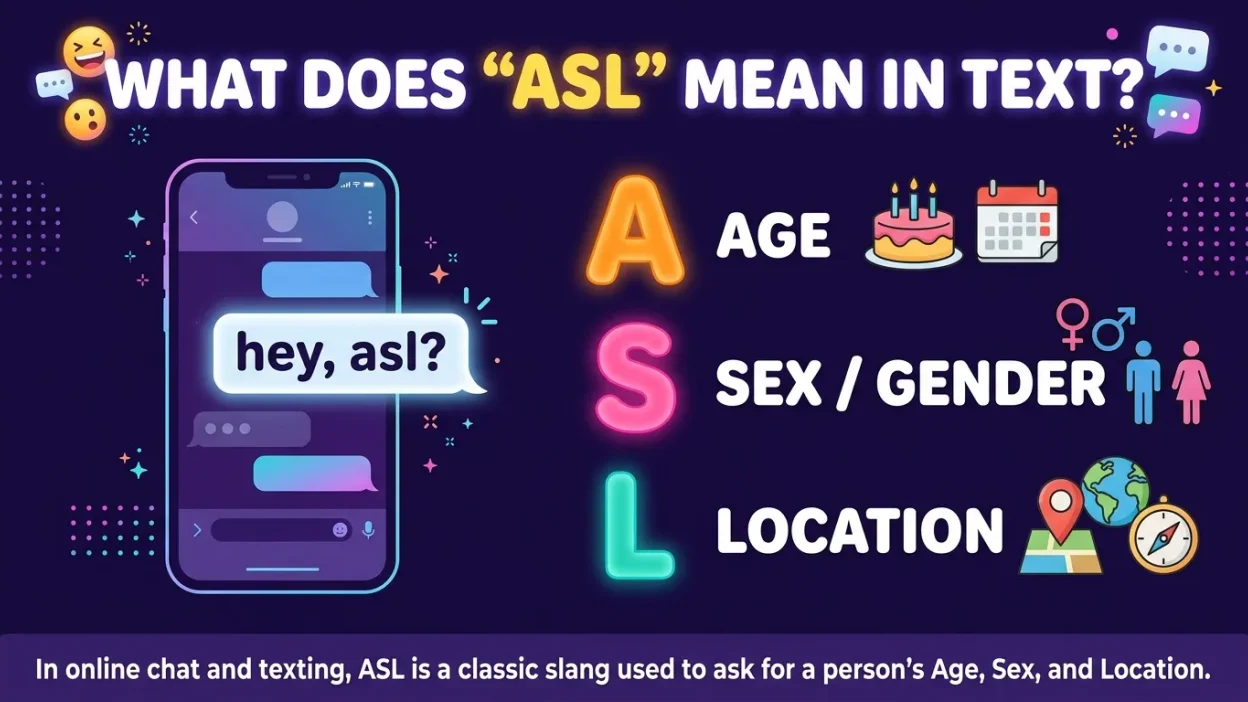
ASL means Age, Sex, Location in traditional internet slang. It is a casual way to ask someone about their age, gender, and where they live.
What Does ASL Mean in Text?
In texting and online conversations, ASL traditionally stands for Age, Sex, Location. People used this abbreviation to ask someone three basic questions: how old they are, their gender, and where they are located.
For example, if someone sends you ASL? in an online chat, they may want to know your age, gender, and general location. This expression became popular in early internet chat rooms and instant messaging platforms, where people wanted to learn more about strangers quickly.
Today, ASL can still appear in online conversations, although its use depends on the platform and the people chatting.
You should always consider the surrounding conversation to understand which meaning someone intends.
Example:
- Person A: hey, asl?
- Person B: 22, female, texas 😊
In this example, Person A is asking for the other person’s age, gender, and location.
In short: ASL = Age, Sex, Location = a way to ask about someone’s age, gender, and whereabouts.
Where Is ASL Commonly Used?
ASL appears in different online spaces, especially when people meet new friends or communicate with strangers. However, its traditional meaning is less common in some modern conversations than it was in early internet chat rooms.
Here are some places where you might encounter it.
- 📱 Text Messages: People may use ASL when introducing themselves or asking basic questions about someone they have just met online.
- 👻 Snapchat: Someone might use ASL while chatting with a new contact, although the meaning depends on the conversation.
- 🎵 TikTok: ASL can appear in comments, captions, or discussions about internet slang and online communication.
- 💬 Online Chat Rooms: This is where the Age, Sex, Location meaning became especially popular.
- 🎮 Gaming Chats: Players may encounter ASL when talking to unfamiliar people in multiplayer games or gaming communities.
- 🌐 Social Media: People may use the abbreviation while making new connections or discussing slang.
ASL is generally considered casual internet slang when it means Age, Sex, Location. It is not suitable for most professional emails or formal workplace conversations.
Remember that ASL also commonly stands for American Sign Language. In conversations about accessibility, education, interpreting, or Deaf culture, that meaning is often more relevant.
Examples of ASL in Conversation
The best way to understand ASL is to see how people might use it in everyday online conversations. These examples show its traditional meaning in casual chats.
1. Meeting Someone New
- A: hey! nice to meet you
- B: you too 😊
- A: asl?
- B: 21, female, california
2. Chatting on Snapchat
- A: heyy, where are you from?
- B: texas! wbu?
- A: new york 😄 asl?
- B: i’m 20
3. Joining an Online Chat Room
- A: hi everyone!
- B: hey 👋
- A: anyone wanna chat?
- B: sure, asl?
4. Making a New Friend
- A: you seem cool lol
- B: haha thanks 😂
- A: asl?
- B: 24, male, florida
5. Talking to a Stranger Online
- A: hey, what’s up?
- B: not much, just chilling
- A: asl?
- B: i’d rather get to know you first 🙂
6. Asking About Someone’s Location
- A: where are you texting from?
- B: chicago
- A: oh nice! asl?
- B: i’m 19
7. Understanding a Different Meaning
- A: my friend is learning ASL
- B: really? that’s awesome!
- A: yeah, she’s taking sign language classes 🤟
- B: that’s so cool
In the final example, ASL means American Sign Language rather than Age, Sex, Location. This shows why context matters when interpreting abbreviations.
When to Use and When Not to Use ASL
ASL can be useful in informal online conversations, but it is important to consider your relationship with the other person and the situation.
✅ When to Use ASL
- Casual conversations: Use it when chatting informally with someone who understands internet slang.
- Online introductions: You may encounter it when people ask basic questions while meeting new contacts.
- Slang discussions: Use it when explaining or discussing traditional internet abbreviations.
- American Sign Language topics: Use ASL when talking about the language, signing, or Deaf culture.
- Friendly online chats: It may be appropriate when both people are comfortable with informal communication.
❌ When Not to Use ASL
- Professional emails: Avoid using unexplained slang in workplace communication.
- Formal introductions: Ask questions naturally instead of relying on abbreviations.
- Sensitive conversations: Do not pressure someone to reveal their age, gender, or location.
- Conversations with strangers: Be careful about sharing personal information with people you do not know.
- Situations where the meaning is unclear: Spell out what you mean to prevent confusion.
ASL Usage by Context
| Context | Example Phrase | Why It Works |
|---|---|---|
| Friend Chat | asl? 😊 | Casual internet slang |
| New Online Contact | how old are you, and where are you from? | Clear and friendly |
| Work Chat | Could you tell me a little about yourself? | Polite and professional |
| Please share any relevant background information. | Formal and clear | |
| Sign Language Discussion | I’m learning ASL. 🤟 | Refers to American Sign Language |
Privacy tip: You never have to share your age or location with someone online. If a question makes you uncomfortable, you can politely decline to answer.
Similar Slang Words or Alternatives
If you see ASL in a message, you might also come across other abbreviations used in texting and online conversations.
| Slang | Meaning | When to Use |
|---|---|---|
| WYD | What You Doing? | Asking what someone is doing |
| WYA | Where You At? | Asking someone’s whereabouts |
| HBU | How About You? | Returning a question |
| WBU | What About You? | Asking for another person’s response |
| HMU | Hit Me Up | Inviting someone to contact you |
| IRL | In Real Life | Talking about offline activities |
These abbreviations have different meanings from ASL, but they can appear in similar casual conversations.
For example, someone might say WYA? when asking where you are, while ASL? traditionally asks for your age, gender, and location. Although both can involve location, they are not interchangeable.
FAQs About ASL Meaning in Text
1. What does ASL stand for in texting?
ASL traditionally stands for Age, Sex, Location. It is an abbreviation used to ask someone about their age, gender, and location.
2. What does ASL mean on Snapchat?
On Snapchat, ASL may mean Age, Sex, Location when someone is asking basic questions about you. The exact meaning depends on the conversation.
3. What does ASL mean on TikTok?
On TikTok, ASL can refer to Age, Sex, Location or American Sign Language. Context helps you identify the intended meaning.
4. Is ASL slang?
Yes, ASL is traditional internet slang when used to mean Age, Sex, Location. It is commonly associated with informal online communication.
5. Does ASL mean American Sign Language?
6. Is ASL flirty?
ASL is not inherently flirty. Someone might use it while getting to know a potential romantic interest, but the abbreviation itself is simply a question.
7. Is ASL rude to say?
Not necessarily. It is informal, but asking personal questions can make some people uncomfortable. Be respectful if someone does not want to answer.
8. How should I reply to ASL?
If you feel comfortable, you can share the information requested. For example, you might reply with your age and general location. You can also say, I’d rather not share that yet.
9. Is ASL still used today?
Yes, you may still encounter it online, but its popularity varies by platform and age group. American Sign Language is also widely referred to as ASL.
10. What is the difference between ASL and WYA?
ASL traditionally asks about age, gender, and location, while WYA means Where You At? and focuses on someone’s whereabouts.
11. Can ASL have different meanings?
Yes. Its meaning depends on context. In internet slang, it can mean Age, Sex, Location, while in discussions about signing, it usually means American Sign Language.
12. Should I answer ASL from a stranger?
Only if you feel comfortable. Avoid sharing identifying or sensitive information with strangers, and remember that you can always choose not to respond.

Olivia Bennett is a writer at MeaningNetworks, creating clear, engaging articles about texting slang, internet abbreviations, emojis, and social-media language to help readers understand modern digital communication.